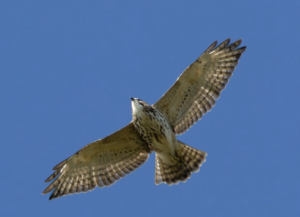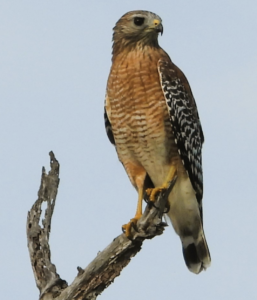

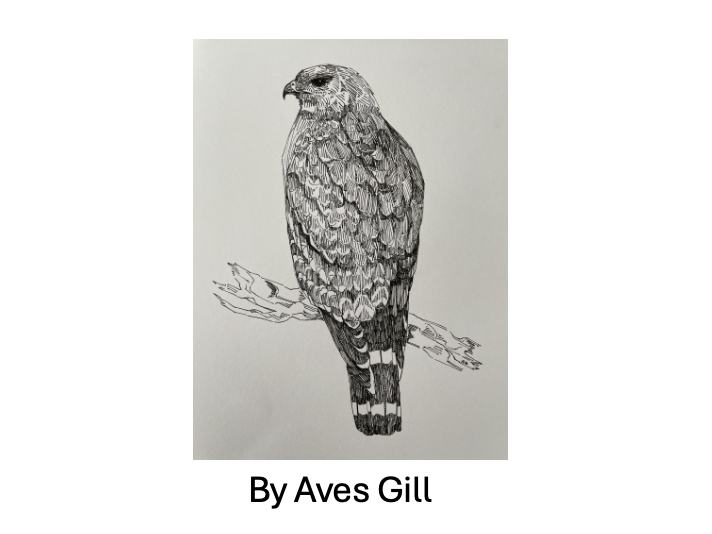
The red-shouldered hawk (Buteo lineatus) is one of many species that enjoy the unique swampland habitat that Dragon Run offers; it can be both seen soaring over the treetops and heard making its distinctive kee-aah call. The species gets its name from the reddish-brown coloration of its chest, shoulders, and head. They measure 17 to 24 inches in length and have a respectable wingspan of approximately 37 to 44 inches, just slightly smaller than a red-tailed hawk. In flight, one can see the barred black-and-white wing and tail feathers that give the bird its scientific name (lineatus in Latin translates to lined). It has the typical piercing stare and talons possessed by most hawks, with dark brown eyes and a yellow-gray beak and legs.
This hawk is found throughout most of the eastern United States; although present for most of the year in many places, the red-shouldered hawk does migrate, breeding in New England and wintering in central Mexico. They prefer wetter environments, including deciduous swamps and bottomland hardwood forests. A diet generalist, the red-shouldered hawk consumes a variety of small animals, including rodents, rabbits, lizards, snakes, amphibians, small birds, and fish. They hunt by searching for prey from above, either by soaring or from a perch, then diving down to catch it.
During breeding season (April through July), breeding pairs will often re-use and build upon old nests, or build a new nest together. They prefer to place their nests high up, but not above the forest canopy, and near water. Females incubate the eggs, usually numbering two or three, while males defend the surrounding territory and hunt. While the hatchlings are born altricial and nearly helpless (being blind and lacking feathers), they are ready to leave the nest at six weeks old. However, they are known to stay close to their parents for up to 19 weeks.
Although now stable, Buteo lineatus has faced several historical threats in the past. The red-shouldered hawk was often targeted by settlers who raised domestic fowl as a protective measure. In reality, predication was rare, and the role the hawks played in balancing many prey populations was likely beneficial to farming endeavors. Populations declined in the early twentieth century due to hunting and deforestation (particularly of hardwood forests), then declined again with the widespread use of DDT, but have thankfully bounced back due to extensive protections. Today, the red-shouldered hawk is of low conservation concern thanks to protections for the species and its habitat, leaving peacefully out in the wetlands.
Photos from Macaulay Library