

October 2026 (archived from 2024)
“‘I want to suck your blood’? I’d rather eat your bugs!” – Virginia bats
Despite what Halloween may lead you to believe, bats are not Dracula in disguise. Rather, bats are friends to ecosystems around the world, serving as pest control and even pollinators.
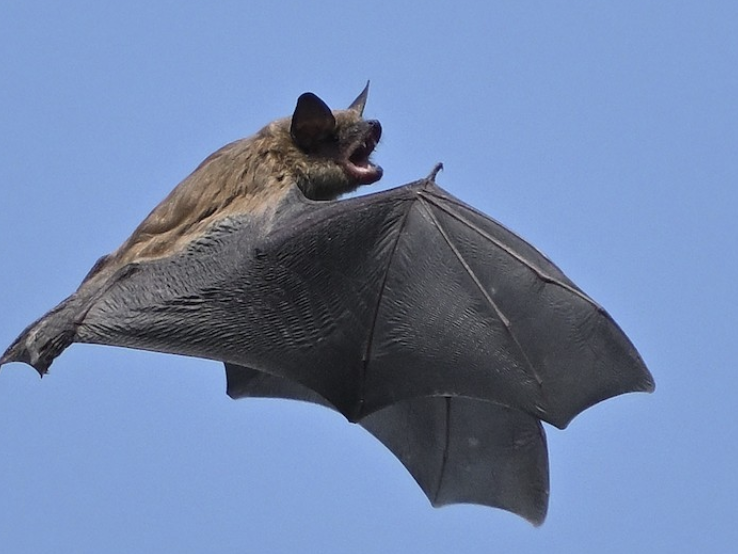
Bats make up two major groups: Megachiroptera and Microchiroptera. Microchiroptera is an insect-eating type of bat found in Virginia and contains two smaller groups: cave bats and tree bats. As the names suggest, cave bats hibernate in caves, while tree bats hibernate in the cavities of trees, woodpiles, and loose rock. Cave bats tend to form larger groups during winter hibernation, while tree bats are more solitary. Of the 17 species of bat in Virginia, FODR has recorded at least 7 in the Dragon Run watershed: Big Brown (above), Eastern Red, Evening, Hoary, Little Brown, Silver-haired, and Tri-colored bats.
Bats evolved about 65 million years ago and are the only mammals capable of sustained flight. As part of the Order Chiroptera, meaning “hand wing,” bats are particularly impressive fliers. Elongated fingers along their wings allow bats to hover, fly backward, dive, and roll in the air.
These flying feats, combined with echolocation, make bats experts at catching insects, a staple of the Microchiroptera bat diet. Echolocation is the ability of bats to emit high-frequency sound waves that bounce off insects and other objects, returning an echo that provides the bat with information about its distance, direction, and size. This hunt for insects is one reason bats are so ecologically important, keeping populations of flies, moths, and mosquitos under control. Some bats may eat up to 3,000 insects in one night!