

September 2026
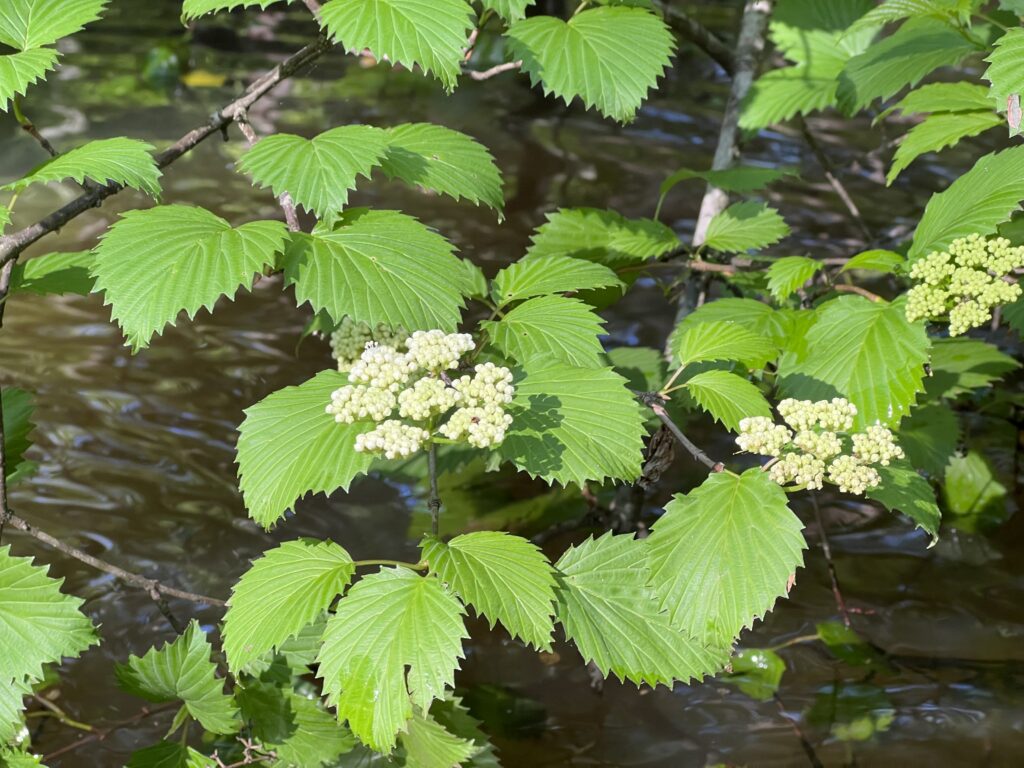
The deciduous shrub, Southern Arrow-wood, Viburnum dentatum, is a standout among our native viburnums for its beauty and ecological value. It is common in the Coastal Plain of Virginia in moist floodplain forests and seepage and alluvial swamps, but despite its affinity for moist soils, it can also be found in dry upland woods. Arrowwood is especially common along the edges of the Dragon Run Swamp. It is a real showstopper from spring to early fall, first with its 3-4 inch flat-topped clusters of showy white flowers which become clusters of 1/3” diameter fruit in the early fall. The fall fruits all ripen at the same time to a deep blue and then blue-black. The fruit is particularly showy against the colorful fall foliage of yellows to vivid reds. These fruits are highly sought by Fall migrating songbirds because they are extremely high in fats attracting flocks of birds that eagerly devour them. Further they are high in antioxidants, thought to lessen the physical stress of long migrations. Interestingly simultaneous fruit ripening is thought to be a recent adaptation among viburnums.
Southern Arrow-wood typically reaches 6 – 10’ in height, with multiple erect straight stems that arch gently outwards giving an overall loosely rounded habit. Like all viburnums it has opposite leaves that are oval to rounded and coarsely toothed or ‘dentate” giving rise to its botanical name. Arrow-wood, as the name suggests, refers to its use by native Americans to make arrow shafts from the straight, strong branches. The nectar-rich flowers attract a variety of native bees including Mason bees and Bumblebees, as well as other pollinators. They are also the hosts to caterpillars of several species of butterflies and moths, including Spring Azure butterflies and the fascinating Clearwing Hummingbird and Azalea Sphinx Moths. The showy clusters of late summer-fall fruit are particularly important to a number of songbirds such as Eastern Bluebirds, Northern Flickers, Thrushes, Robins, Cardinals as well as gamebirds such as grouse and wild turkeys, not to mention small mammals that eagerly seek their fruit. On your next trip into the Dragon be sure to look for Southern Arrow-wood along the edges of the swamp and the flocks of birds attracted to their distinctive fruit.
Photos by Betsy Washington and Kevin Howe