

July 2026
Long-legged waterbirds of the Ardeidae (herons, bitterns, and egrets) are a common sight in Virginia’s wetlands. Dragon Run now welcomes a new member of this family into its waters: the green heron (Butorides virescens).
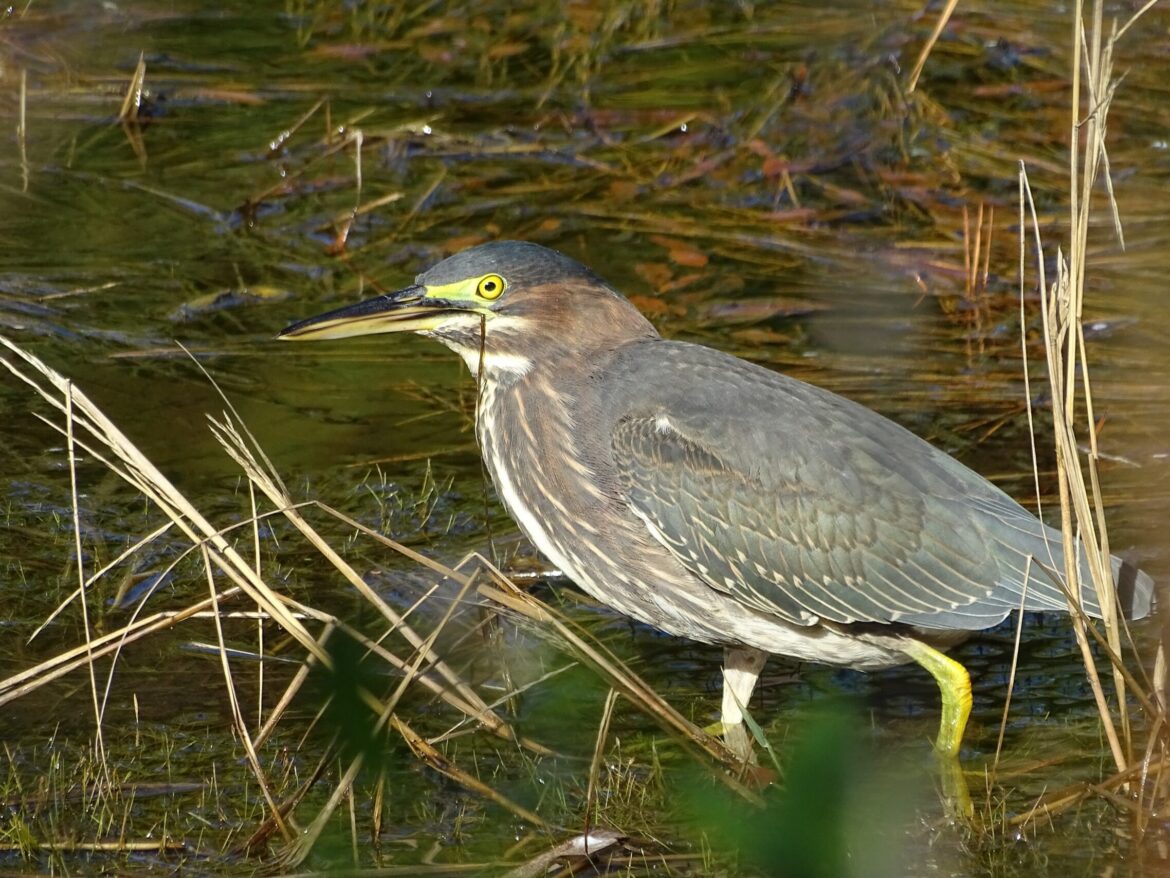
The green heron is on the smaller side, with an adult body length of 17 inches and an adult wingspan of 26 inches across. They tend to stand with their heads tucked close into their body. They get their name from the greenish-black color of their heads and wings (Butorides virescens can roughly translate to mean a “bittern-resembling, greenish” bird). Their bodies are a chestnut color that fades to gray near the stomach, with a few white lines running down their neck and chest. They have a sharp black beak, yellow eyes, and dull yellow-orange legs.
Unlike other prominent species in Ardeidae, the green heron is far more slippery. They avoid open wetland areas in favor of sticking to dense foliage they can blend in with. Green herons tend to forage alone, preferring to stand on shorelines or tree branches to await prey. They are known to use objects like bread or insects to attract prey, a practice called bait-fishing. They will even scare other birds away from their bait setups. Many ecologists consider bait-fishing to be a form of tool use, though it is unclear whether the herons must learn the behavior or know it innately.
The green heron visits Virginia each year between April and September to breed. Its full breeding range extends across most of the eastern United States, while its wintering range encompasses central Mexico. However, the herons are found year-round on the coasts of Mexico and the southern coast of the United States. During breeding season, they choose one mate to spend the summer with, with males courting females. The male chooses the nest site and begins construction, later helped along by the female. Green herons prefer secluded sites and are not too picky about height (from ground level to 30 feet above) or tree type, so long as they are close to the water. Together the parents raise clutches of 3-5 eggs and can breed one or two times a season.
While the species is classified as “least concern” in terms of endangerment, conservation groups are keeping a close eye on the green heron because of consistent population decline over the last half century. The dependence these birds have on wetlands to feed and raise young means that conservation of Dragon Run is as important as ever to help prevent the green heron from slipping into endangerment. Though they are but one of many species that carve out a home in the Dragon, the combination of their smart camouflage and elusive behavior means that spotting a green heron is a lucky sight indeed.
https://en.wikipedia.org/wiki/Green_heron#Ecology
https://www.allaboutbirds.org/guide/Green_Heron/lifehistory#conservation
https://digitalcommons.usf.edu/cgi/viewcontent.cgi?article=2795&context=bird_observer