
June 2026
The Eastern Fence Lizard (Sceloporus undulatus) is also known as the Pine Tree Lizard for their love of pine trees. In pines, they can climb to escape predators. These absolutely adorable creatures hang-out in open dry forests of all sorts, in fields, old barns and rocks. Often found sitting on rocks and fence posts to sun themselves, these lizards choose their home site based on sunlight availability. At night and in the winter, they will hunker down amongst wood piles, under bark or in tree holes.
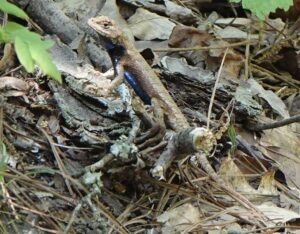
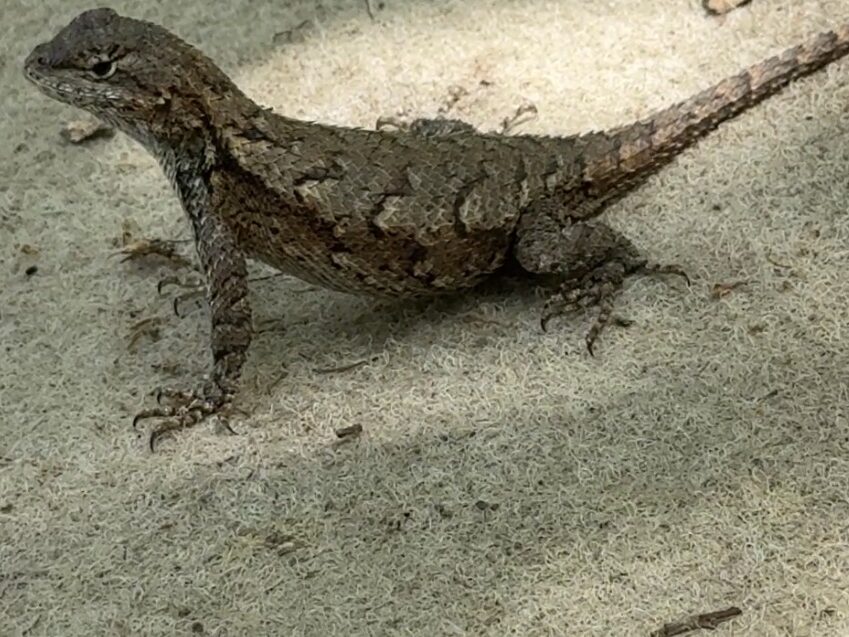
They have holes or pores in their legs and wavy lines on their backs (the species name translates to wavy). The females are larger than the males. Ranging from 4 to 7 inches. The record in VA being 7.5 inches. The males have a beautiful blue/green coloration on their undersides. To attracting passing females or to ward off potential interlopers, the lizards will flash this coloring by doing push-ups. They are the only lizard in the US with keeled scales (distinct ridge running down the center, much like the keel of a boat) making them easily identifiable.
Eastern Fence Lizards use a “sit and wait” hunting approach to capture their meals which consist of beetles and other insects as well as snails. They are preyed upon mostly by snakes but also by birds and other carnivores. These creatures are extremely quick, climbing trees and hiding on the opposite side so capture is difficult. The lizard’s tails can break off and regenerate like a skink.
Mating begins in early spring and eggs are laid underground June through July. The parents do not hang around. The babies, which are 2 - 3 inches long, are on their own when they hatch sometime between August and September. They are easily predated.
Ranging far in the Southeast US, these cute little creatures are currently not under conservation status. But habitat loss and poaching are real problems.
Maybe the Eastern Fence Lizard is why they call it the Dragon!